Choosing the right logo technique for your brand can be frustrating. Suppliers recommend different options—embossed, laser-engraved, screen-printed, or pad-printed—and quotes vary significantly. Embossing requires tooling upfront, risking wasted budget if your artwork changes. Laser engraving might compromise the electroplated layer and cause peeling. Screen and pad printing cost less initially, but poor ink adhesion could lead to scratching and flaking. The best choice doesn’t depend on what a supplier pushes. It comes down to three factors: cap geometry, logo colors, and your production volume.
On zinc alloy caps, raised lettering comes directly from the die-casting mold cavity. Laser engraving burns off surface coatings to reveal the substrate. Screen and pad printing transfer ink onto the surface. These four methods rely on fundamentally different manufacturing principles. Your chosen surface finish—electroplating, PVD, or spray coating—also dictates which logo method you can use. Here is how they compare.
Quick Comparison of the Four Logo Methods
| Parameter | Embossed / Debossed | Laser Engraving | Screen Printing | Pad Printing |
|---|---|---|---|---|
| Process Principle | Formed directly in the mold cavity; no secondary processing | Fiber laser burns surface coating to create contrast | Ink pushed through a mesh screen, followed by heat curing | Silicone pad picks ink from the etched steel plate and transfers it to cap |
| Durability | ★★★★★ Integrated with metal substrate; permanent | ★★★★☆ Permanent marking, but cuts through electroplating | ★★★☆☆ Wear resistance depends on ink grade and curing | ★★★☆☆ Similar to screen printing |
| Design Flexibility | ★☆☆☆☆ Changing logo requires mold modification | ★★★★★ Update digital vector file instantly | ★★★★☆ Replace screen stencil only | ★★★★☆ Replace etched steel plate only |
| Color Capability | ★☆☆☆☆ Base metal color; optional paint filling | ★☆☆☆☆ Single-tone or oxidized contrast | ★★★★★ Full Pantone color matching | ★★★★☆ Multi-color requires multiple print stations |
| Curved Surface Fit | ★★★☆☆ Limited by parting line and draft angle | ★★★★☆ Handles mild convex/concave curves | ★★☆☆☆ Best for flat surfaces only | ★★★★★ Deformable silicone pad conforms to curves |
| Typical MOQ | 5,000+ pcs (tooling cost amortization) | 100+ pcs (highest flexibility) | 500+ pcs | 1,000+ pcs |
Among all four methods, only embossed and debossed logos form an integral part of the metal cap. The other three require secondary processing. Embossing offers unmatched durability, but changing your design later means modifying hardened mold steel.
Embossed and Debossed Logos
Raised (embossed) logos are cut directly into the die cavity of the tooling. When molten zinc alloy is injected into the mold, the logo forms as part of the raw casting. It isn’t a secondary add-on, so it never peels or chips off. Recessed (debossed) logos work the same way, using raised features inside the mold to cast depressed grooves into the capcap.
When to choose it: If your brand identity is finalized and your initial order exceeds 5,000 units, embossing is your top option. Once you pay for the mold, every cap comes out with the logo automatically, adding zero per-unit labor cost.
Keep three technical details in mind:
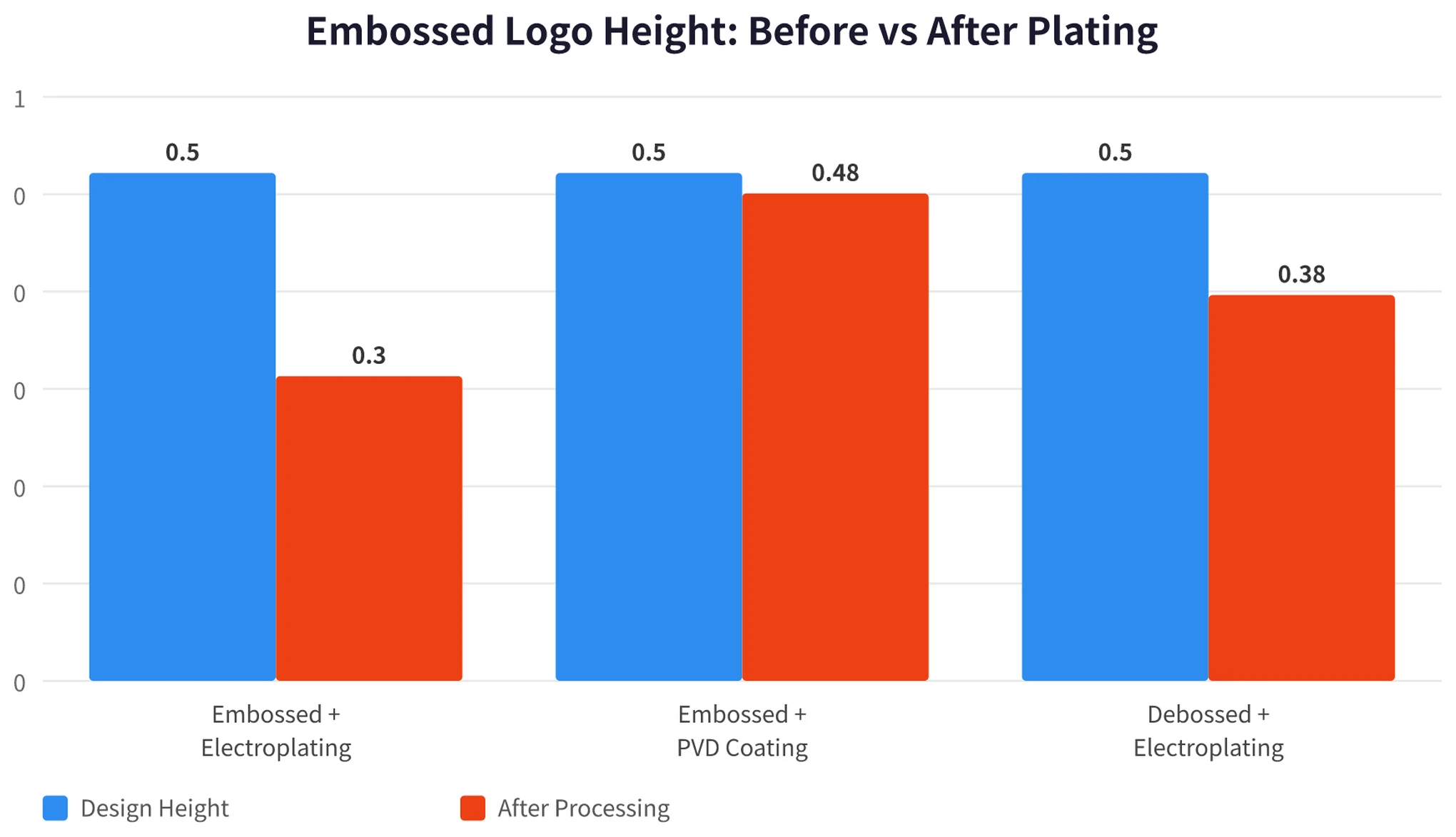
First, electroplating reduces the relief height of raised text more than most buyers expect. Standard rack plating (copper + nickel + chrome) measures only tens of microns thick, but deposit buildup around edges dulls fine contours. In practice, a 0.5 mm raised letter may measure only 0.3 mm after chrome plating. Tooling engineers use a simple design rule: set the mold relief height to 1.5 times the target finished height—or 2.0 times for sharp, serif fonts. Debossed logos lose less depth during plating because electroplating solutions deposit less heavily inside recessed pockets. Vacuum PVD coating creates virtually zero dimensional loss, though it demands a flawless polished surface underneath.
Relief height before vs. after plating: A 0.5 mm design drops to ~0.3 mm after electroplating—a visible difference. PVD coating causes almost no loss, and debossed logos retain more depth.
Second, insufficient draft angles cause parts to stick in the mold and tear off lettering. Draft angle is the taper along the vertical walls of the letter. Think of pulling a boot out of thick mud—slanting the foot helps it release cleanly, while pulling straight up creates suction. A raised letter corresponds to a pocket in the mold cavity. As the zinc casting cools and ejects, inadequate draft will shear the metal. Safe industry practice requires a minimum 3-degree draft angle for raised text and at least 5 degrees for debossed text. Deeper features demand larger angles.
Third, buffing wheels easily round off sharp edges on raised lettering. Raw zinc alloy die-casting parts have rough surfaces that require mechanical polishing before plating. High-speed buffing wheels wear down the crisp edges of raised letters. Taller lettering and heavy mirror-polishing increase this edge rounding. For high-mirror finishes, debossed text holds up much better than raised text.
Tooling costs: If you select an existing open-mold cap from your supplier, adding an embossed logo does not require building a whole new mold. The factory uses interchangeable logo inserts (small hardened steel blocks). Swapping an insert in the Dongguan manufacturing hub typically costs around $74 to $297 (CNY 500 to 2,000). If you develop a custom bespoke cap, the logo engraving is already factored into the complete mold tooling fee. Standard open-mold perfume caps from Wbmetal (series WJ7001 through WJ7097) all support top logo inserts.
Laser-Engraved Logos
Laser marking uses a focused fiber laser beam to ablate or oxidize the top surface layer. Here is a critical technical rule: never laser-engrave raw, unplated zinc alloy. Raw zinc has a silvery-gray finish; laser burns leave a faint grayish mark with almost zero contrast. You must apply a dark surface finish first—such as gunmetal electroplating, black chrome, or dark spray coating. The laser then strips away the dark coating to expose the lighter zinc underneath, creating crisp visual contrast.
When to choose it: If your logo artwork isn’t finalized, if your product line includes multiple sub-brands, or if your run is only a few hundred units, laser engraving provides the highest flexibility. You simply update the vector file on a computer without touching tooling. Production runs as small as 100 pieces are practical. Laser engraving delivers outstanding visual depth on dark electroplated finishes like gunmetal or black chrome.
The primary drawback: laser engraving compromises the electroplated barrier. Laser marking takes place after electroplating. The laser burns through the surface finish to create the mark. Decorative chrome layers measure just fractions of a micron, allowing the laser to cut through easily. This exposes the underlying nickel layer and raw zinc alloy substrate. Thermal stress from the laser beam also introduces microscopic cracks in the adjacent plating, creating pathways for moisture and corrosion. Salt spray resistance drops sharply—technical data shows aluminum parts drop from dozens of hours to single-digit hours after unsealed laser marking, and zinc die castings follow the same pattern.
Laser marking damage progression: The laser penetrates decorative chrome, exposes nickel and zinc substrate, and initiates corrosion. Applying a post-laser sealer restores salt spray performance close to original levels.
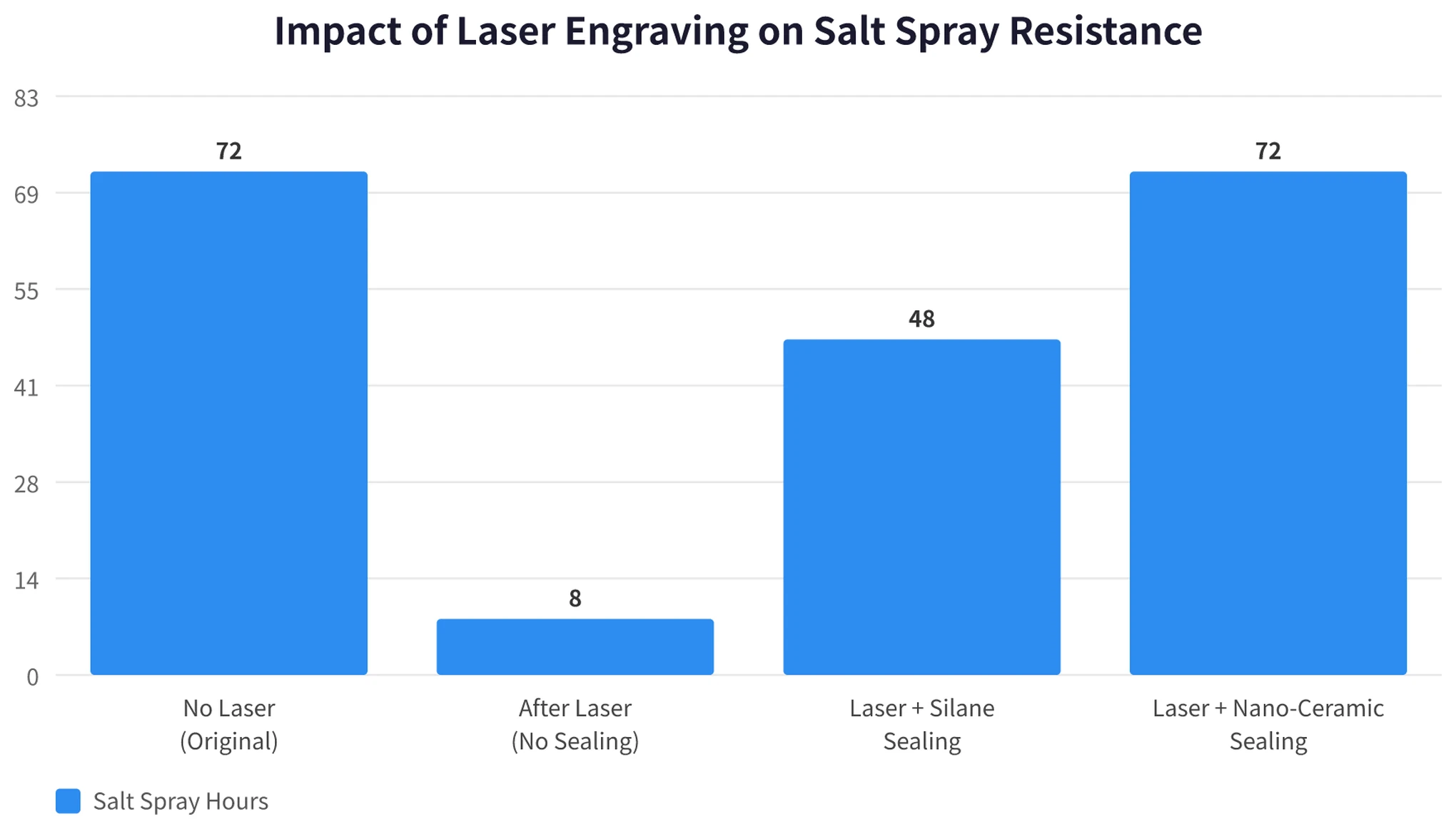
To avoid corrosion, factories must apply a post-laser sealing treatment—a clear protective coating over the engraved area. Silane or nano-ceramic sealing brings corrosion resistance back up to dozens of hours. Shipping unsealed parts frequently leads to plating delamination and edge flaking within days of delivery.
Laser engraving delivers the finest resolution among all four methods, producing line widths as narrow as 0.05 mm for tiny typography, serial numbers, and micro QR codes. Unit costs average $0.04 to $0.22 (CNY 0.3 to 1.5). Equipment selection matters greatly: standard Q-switched fiber lasers generate larger heat-affected zones that leave burnt, rough edges. MOPA fiber lasers offer adjustable pulse widths, stripping coatings cleanly with sharp, defined boundaries. Asking your perfume caps manufacturer what laser source they use is an easy way to evaluate their technical capability.
Screen-Printed Logos
Screen printing functions like apparel printing: ink is forced through mesh openings defined by a stencil onto the cap, followed by high-temperature oven curing. Its biggest advantage is unrestricted color matching across the entire Pantone formula guide.
When to choose it: If your brand identity requires specific corporate colors—such as Tiffany Blue or Hermès Orange—screen printing is the standard choice. It requires a relatively flat or very gently contoured cap top.
The main challenge: ink adhesion failure. Zinc alloy surfaces present three adhesion barriers. First, die-casting mold-release agents leave invisible oily residues that cause pinholing. Second, smooth electroplated finishes offer no mechanical tooth for ink anchoring. Third, non-porous metal resists chemical wetting. Without surface prep, printed ink wipes off like dry-erase marker on glass.
Professional production relies on a three-step protocol: First, clean the substrate with atmospheric plasma treatment or apply an adhesion-promoting chemical primer. Second, use two-component epoxy or polyurethane metal inks. Third, bake at specified curing temperatures and cycle times. Done correctly, the print passes ASTM D3359 cross-hatch adhesion testing at Class 4B or higher. Skipping surface preparation means the logo will scratch off with a fingernail. Always ask potential suppliers if they include plasma or primer pre-treatment in their quote.
Screen printing works reliably only on flat surfaces. If the cap has a pronounced dome or curve, the rigid mesh frame cannot conform, resulting in blurred edges. Curved tops require pad printing or laser engraving instead.
In terms of cost, screen printing is economical: mesh stencils cost around $15 (CNY 100) per color, and per-piece print costs run a few cents ($0.03 to $0.07 / CNY 0.2 to 0.5). However, resolution is limited; lines below 0.3 mm become difficult to reproduce cleanly. For large-volume runs of flat, solid-color graphics, screen printing offers an efficient solution.
Pad-Printed Logos
Pad printing (tampon printing) uses an indirect offset process: the logo is chemically etched into a flat steel cliché plate, ink fills the etched recesses, and a flexible silicone pad picks up the ink film and stamps it onto the cap. Because the silicone pad deforms under pressure, it conforms to curved surfaces that rigid screens cannot touch.
When to choose it: If your cap top has a dome, compound curve, or stepped contour and requires a colored logo, pad printing is the ideal method. Most luxury fragrance packaging components feature curved profiles, making pad printing a staple process.
Pad printing achieves higher detail than screen printing, holding line widths down to 0.15 mm with multi-color registration accuracy within ±0.05 mm. However, the transferred ink film is thin (4 to 10 microns, roughly one-third the thickness of screen printing). This lower opacity means printing white ink on a dark gunmetal cap may require two passes to prevent bleed-through. Like screen printing, electroplated surfaces require plasma pre-treatment or primer for durable bonding.
Zinc alloy die castings present one specific risk in pad printing: the parting line. The seam where mold halves meet leaves a faint witness line across the casting. Even after polishing, slight microscopic variations may remain. When the silicone pad stamps over this ridge, ink transfer can skip, creating broken lines. The solution is thorough parting-line polishing or using softer silicone pads to improve surface contact.
Pad hardness (durometer) must match the geometry: curved caps require soft pads (8 to 12 Shore A) that deform readily without distorting the graphic, though soft pads wear out after several thousand impressions. Flat surfaces use firmer pads (15 to 20 Shore A) for longer service life and sharper line edges.
Tooling plates cost roughly $22 to $59 (CNY 150 to 400) per color, with per-unit printing costs around $0.02 to $0.09 (CNY 0.15 to 0.60). Multi-color artwork requires dedicated printing stations or sequential plate changes, increasing labor and lead times.
How to Choose: 3 Decision Questions
Question 1: Is your cap top flat or curved?
- Flat → All four methods work; proceed to Question 2.
- Curved → Eliminate screen printing; choose pad printing or laser engraving.
Question 2: Does your logo require brand-specific Pantone colors?
- Bare-metal or monochrome contrast → Embossing/debossing or laser engraving.
- Specific Pantone brand colors → Screen printing or pad printing.
Question 3: What is your production volume and project stage?
- Established brand, fixed logo, 5,000+ pcs → Embossing (tooling-integrated, zero per-unit logo cost).
- New launch, evolving branding, a few hundred pcs → Laser engraving (zero mold changes).
- Established brand, fixed logo requiring color, high volume → Screen printing (most economical for flats).
- Any project stage, curved cap with color logo → Pad printing.
| Project Scenario | Recommended Method | Primary Reason |
|---|---|---|
| Established brand + flat cap + metal finish logo | Embossed / Debossed | Permanent; zero recurring per-piece logo cost |
| New brand / unfinalized logo + dark plated cap | Laser Engraving | Design changes require no tooling; 100 pc MOQ |
| Flat cap + custom Pantone brand colors | Screen Printing | Full color gamut; lowest high-volume unit cost |
| Curved cap + multi-color logo | Pad Printing | Silicone pad conforms to curves; higher resolution than screen |
| Premium budget + tactile luxury aesthetic | Embossing + Laser | 3D relief base with laser-contoured outlines for contrast |
Hybrid techniques also deliver outstanding results. Combining debossed relief with laser outline etching or enamel color filling is common on luxury cosmetic packaging and premium caps. This approach adds dimensional depth and visual contrast, though secondary processing increases unit costs.
Frequently Asked Questions
Will electroplating obscure an embossed logo?
Plating rounds sharp edges and reduces relief height, but the logo remains clearly legible. Standard rack electroplating reduces a 0.5 mm raised letter to roughly 0.3 mm. To compensate, design your mold cavity with at least 0.6 mm relief height so the finished piece retains 0.4 mm or more. Debossed lettering experiences less reduction, while vacuum PVD causes almost no measurable loss.
Does laser engraving damage electroplating?
Yes. The laser functions by vaporizing the plated layer to expose the metal below. To prevent corrosion and edge peeling, reputable manufacturers apply a clear silane or nano-ceramic chemical sealer over the engraved area immediately after marking. Always verify whether your supplier includes post-laser sealing in their quality process.
Do screen-printed and pad-printed inks adhere reliably to metal caps?
They adhere reliably only when proper surface preparation is performed. Printing directly onto smooth, plated zinc alloy results in poor adhesion. Following a complete three-step process—plasma pre-treatment or primer, two-component industrial metal inks, and thorough oven curing—ensures the print passes ASTM D3359 cross-hatch tape tests at Class 4B or better.
Does an embossed logo require extra mold tooling charges?
It depends on the tooling approach. When using open-mold cap designs that feature an interchangeable logo insert cavity, you only pay for a new steel insert, which costs about $74 to $297 (CNY 500 to 2,000) in Dongguan. For fully custom bespoke molds, logo CNC engraving is included in the total mold package. Wbmetal’s standard open-mold series (WJ7001 to WJ7097) includes dedicated insert pockets, allowing custom branding without the cost of a full private mold.
Can two logo processes be combined on the same cap?
Yes. You can combine an embossed 3D relief with laser perimeter contouring or enamel color filling. Because this involves two distinct manufacturing setups, ensure your quote itemizes polishing allowances, plasma pre-treatment, and curing standards for both steps to prevent quality disputes.
If you are developing custom caps and need help selecting the right logo process, send your technical drawings or reference samples to Wbmetal. Provide your cap geometry, logo dimensions, and target surface finish, and our engineering team will provide feasibility feedback and a competitive quote.