Metal razor handles now mainly use two alloys. Aluminum alloy is light and leans toward precise, minimalist design. Zinc alloy is heavier, typically paired with bright chrome plating, more complex textures, and vintage styling. Aluminum falls into two main routes. One is 6061, which is CNC-machined and can be color-anodized. The other is ADC12, which is die-cast and cost-effective for high-volume production, but its high silicon content means anodizing usually yields only black or silver, so color anodizing is not recommended. Among these 12 aluminum models, most use ADC12 die casting. Only two models use 6061 CNC: Henson, identified by its bright blue color anodized finish, and KAMPFE GEM, which states 6061 in the title. The zinc models are basically all die-cast.
According to TrendX Insights, the global safety razor market is projected to grow from $2.48 billion in 2025 to $6.25 billion by 2034, at a CAGR of 10.8%. Another research firm, Fortune Business Insights, puts the overall razor market at $18.71 billion by 2034, with a CAGR of 3.97%. Safety razors are growing at more than twice the rate of the overall market. That segment is exactly where metal handles dominate, driven by the return of wet shaving and growing dislike of disposable plastic handles.
At Wbmetal, we reviewed metal handles on Amazon labeled as aluminum or zinc alloy. We collected 20 models and broke them down one by one to compare design and manufacturing differences. This article is intended to help readers quickly understand how the market is selecting materials and processes today.
Start with the difference between aluminum and zinc
Density: Zamak 3 zinc alloy has a density of 6.70 g/cm³, while 6061 aluminum alloy is 2.70 g/cm³ (ASTM B86/B209). At the same volume, zinc weighs about 2.5 times as much as aluminum. A razor handle is something held in the hand, so weight directly shapes how it feels in use.
| Category | Aluminum 6061 CNC | Aluminum ADC12 Die Casting | Zinc Zamak Die Casting |
|---|---|---|---|
| Forming method | Fully machined from bar stock by CNC | High-pressure die-cast blank | Hot-chamber die-cast blank |
| Best production volume | Low volume, no tooling required | High volume, tooling cost can be amortized | High volume, tooling cost can be amortized |
| Tolerance | IT6-IT8 on machined surfaces | CT4-CT7 as-cast, tighter after machining | CT4-CT6 as-cast, tighter after machining |
| Weight at same volume | ~40 g (density 2.70) | ~40 g (density 2.70) | ~100 g (density 6.7) |
| In-hand feel | Light, cool on first touch | Light | Substantial, smoother, and warmer in feel |
| Surface finishing | Multicolor anodizing: color, matte silver, brushed | Black or silver anodizing/paint or powder coat/plating; high silicon content prevents color from anodizing | Mirror chrome, gold, or PVD plating; requires copper strike undercoat |
| Yield challenges | Thin-wall distortion, chatter marks | Porosity, die sticking | Skipping copper pre-plating leads to blistering; yield typically 70-85% |
Die casting only forms the blank. The blank still has flash and gates. The surface is still rough, and threaded holes and mating surfaces are not yet finished. It must go through follow-up machining for deburring, tapping, and finishing of fit-critical surfaces, then move on to plating or anodizing. So once aluminum or zinc uses a die-casting route, machining is still unavoidable. Within aluminum, 6061 is not suitable for conventional die casting because its flow behavior is not ideal for the process, and it is prone to hot cracking and die sticking. For aluminum die casting, a high-silicon die-casting grade such as ADC12 is required.
The three materials each follow their own surface-finishing route. 6061 aluminum is anodized under MIL-A-8625. The oxide layer can be dyed in bright blue, gold, red, and other colors. Matte silver and brushed finishes also work. In this group, only Henson’s bright blue finish and KAMPFE GEM use 6061 color anodizing. ADC12 die-cast aluminum contains 9.6-12% silicon. Silicon particles do not dissolve into the anodic film, so anodizing generally produces only black or silver base tones and cannot take dyed colors. If an ADC12 aluminum handle needs color, it has to use paint or powder coating. If it requires a glossy finish, it has to be plated. In this group, Reggie, Goodfellas, and Keropy use mirror chrome, while FREED uses brass-gold plating—all based on ADC12 die casting followed by plating. Zinc alloy is chemically active, so it must first receive a copper strike undercoat before nickel-chrome plating. If that step is skipped, blistering can easily appear within 48 hours of salt spray testing.
In simple terms, 6061 aluminum CNC stands out for color anodizing, low weight, and precision. ADC12 aluminum die casting stands out for low cost at high volume, with the tradeoff that anodizing only yields black or silver, so color requires paint or plating. Zinc die casting stands out for its weight, solid hand feel, glossy vintage styling, intricate textures, and cost-effective high-volume production.
What design styles appear across the 20 models
These 20 models fall into classic, minimalist, vintage, industrial, and affordable luxury styles. On Amazon, the mainstream look for metal handles clusters around three directions: minimalist industrial, mostly aluminum with matte silver, brushed finishes, and fine circular grip lines; vintage classic, mostly zinc with bright chrome plating and diamond knurling; and affordable luxury, with gold plating, rose gold, or wood-end combinations. The surface treatments also split clearly by process route. Multicolor anodizing is the signature of 6061 CNC aluminum. Paint and powder coating are the practical options for ADC12 die-cast aluminum. Mirror-polished plating is the signature finish for zinc.
The 12 aluminum alloy models
Among these 12 models, Amazon titles usually describe them as CNC aluminum or aerospace aluminum. Only one, KAMPFE GEM, explicitly states the 6061 grade. Henson can also be identified as 6061 from its bright blue color anodized finish. In process terms, aluminum handles here mainly fall into two material routes: 6061 bar stock, fully CNC-machined, which supports color anodizing, and ADC12 die casting, which is cheaper but can only anodize to black or silver, so color requires paint or plating. Most mass-market aluminum models in this set are ADC12, typically in silver anodized or chrome-plated finishes. Only Henson and KAMPFE GEM are 6061 CNC.
Minimalist industrial style (8 models)
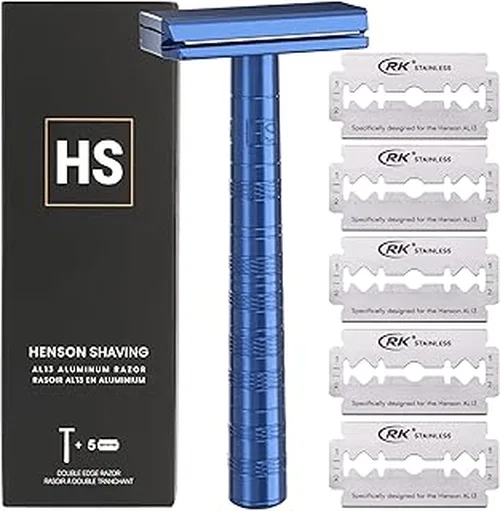
- Henson AL Steel Blue (B0BPJDW1B8): Straight cylindrical barrel with a bright blue hard-anodized finish, full-length fine circular anti-slip grip lines, Canadian aerospace aluminum CNC, 30° fixed shaving angle.

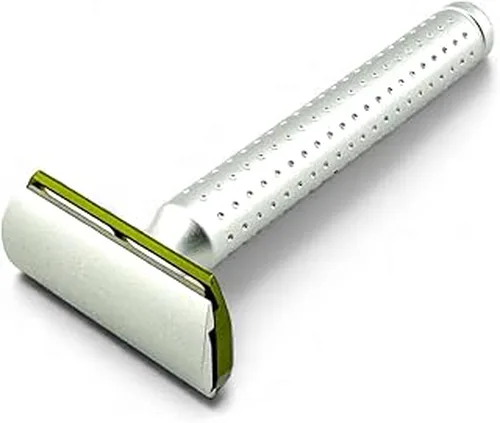
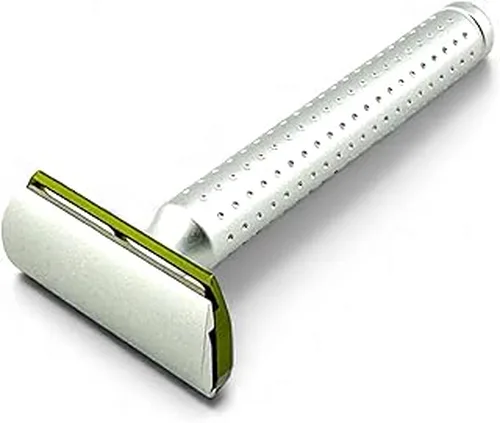
- Parker AeroShave (B0GF435Z5T): Straight barrel with a concave dot-matrix anti-slip pattern, matte silver anodized, with a thin green accent along the head edge.

- Parker AeroShave XL (B0GF3GMHWM): Long-handled version of the previous model, length-to-diameter ratio about 7.2:1.
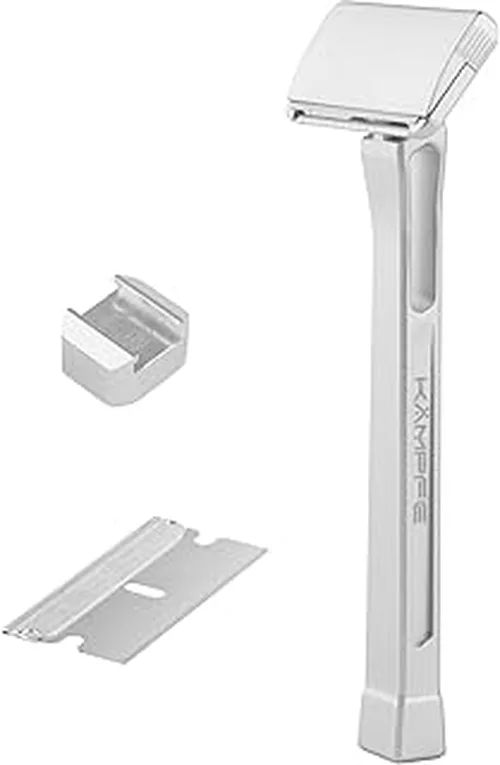
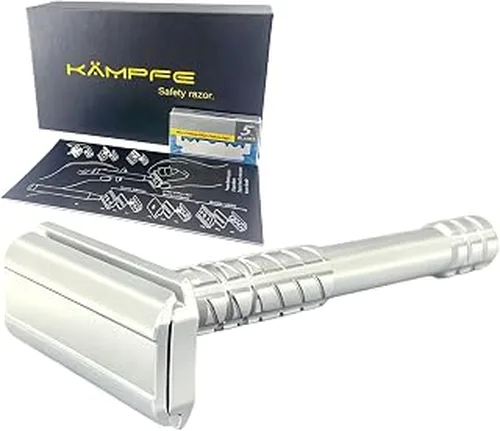
- KAMPFE 6061 GEM single-edge (B0FW5LBBQ9): 6061 aluminum multi-prism barrel, vertical brushed anodized finish with highlights along the prism edges, paired with a GEM single-edge blade.

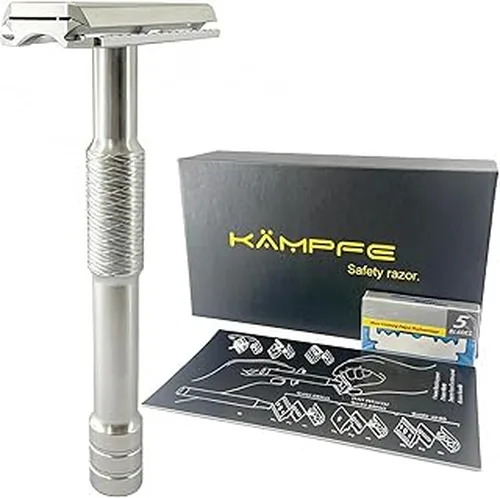
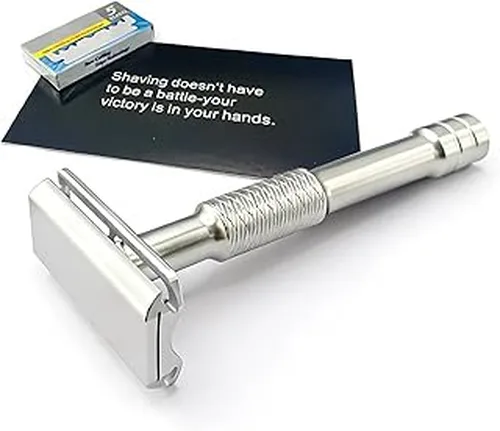
- KAMPFE CNC DE mild (B0G7WWQ7F9): Cross-helical knurling on the middle section, matte brushed finish, mild-type head.

- KAMPFE CNC DE standard (B0H4GJKZZL): Segmented ring-groove anti-slip pattern, full matte silver brushed anodized finish.

- KAMPFE CNC DE aggress (B0GKGM74H4): Three-section design with helical knurling in the middle, brushed finish with localized highlights, aggressive-type head.
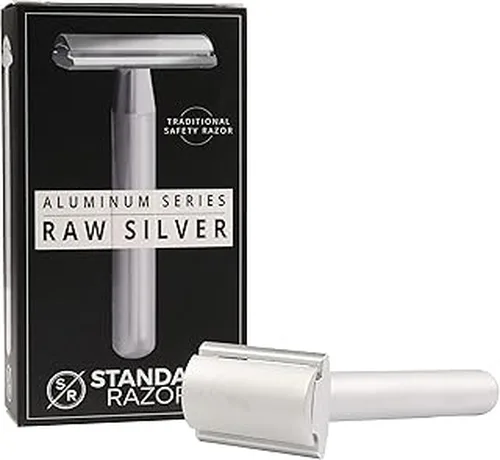
- Standard Razors Raw Silver (B07C39RCPY): Smooth straight barrel with no anti-slip texture, matte brushed silver anodized finish.

Vintage classic style (2 models)
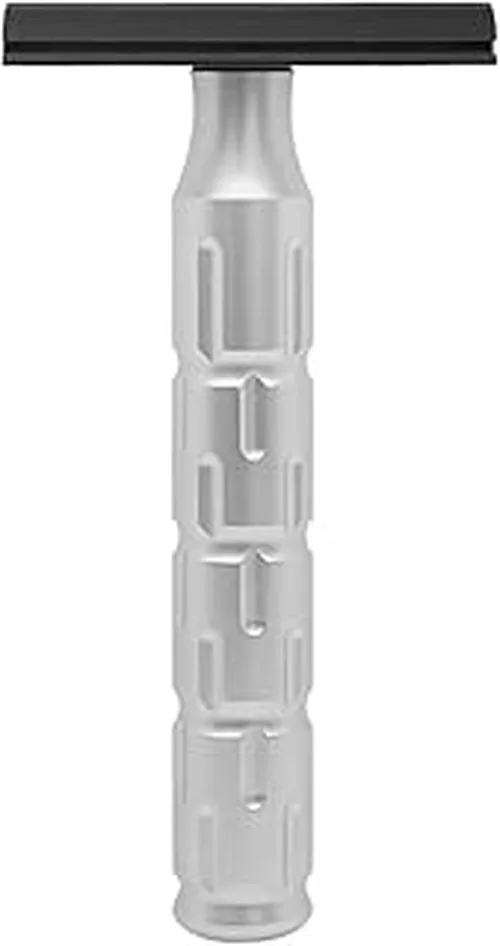
- The Goodfellas’ Smile Syntesi (B0CGVKRVZB): Italian handmade, 4-zone segmented anti-slip pattern (vertical grooves plus J-shaped ribs), mirror bright silver, 45° shaving angle.

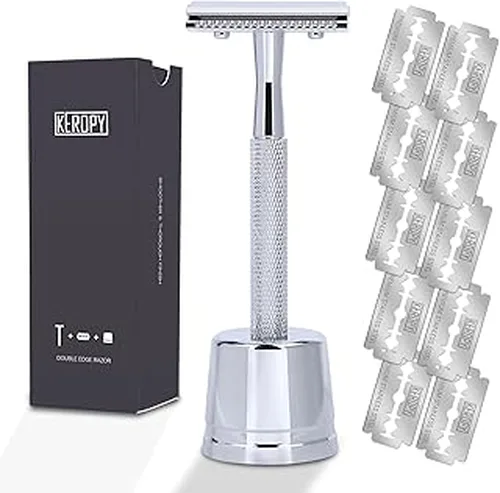
- Keropy (B0F63NTSK5): Diamond knurling on the grip section, paired with a matching chrome-plated vertical stand, sold as a set.

Affordable luxury style (2 models)
- Reggie’s Razors Jupiter (B0FXGT1QB9): Straight long handle with circular knurling, mirror-polished bright silver, title states Aerospace aluminum.

- FREED (B0CRV1W36B): Segmented slightly curved waist, brushed brass-electroplated metal section with bright black handle color contrast, paired with an independent weighted base.

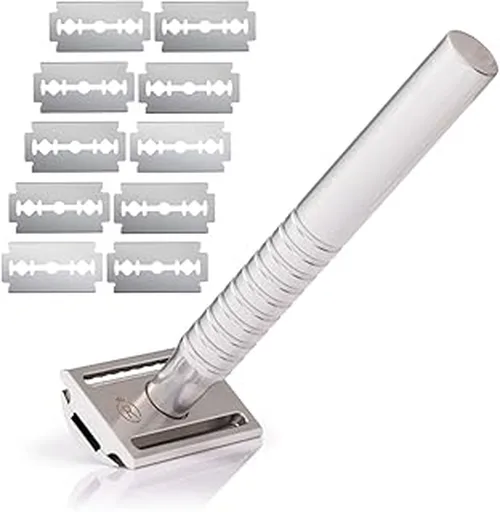
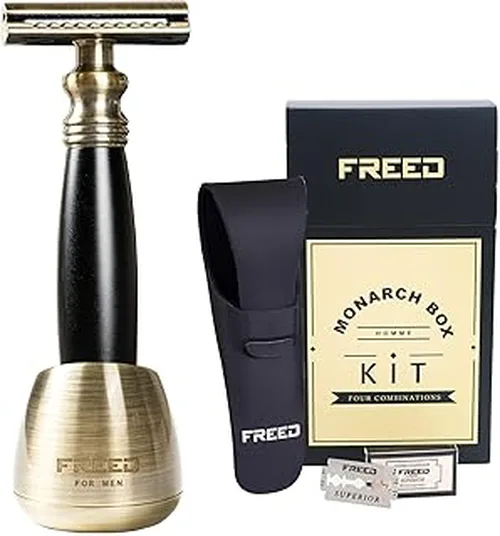
In this group, Reggie Jupiter, Goodfellas, and Keropy all use a mirror-bright chrome look, while FREED uses brass-gold plating. These are all formed by ADC12 die casting and then plated for the glossy finish. None of these razor handles use stainless steel. Bambaw labels stainless steel for the blade, not the handle. For a glossy vintage look, the route is either ADC12 aluminum die casting with plating or zinc alloy die casting with plating. The visual effect can be very similar, but aluminum is light while zinc feels more substantial in the hand.
The 8 zinc alloy models
These are mainly based on die casting plus plating, with solid weight, bright chrome or gold finishes, and vintage knurled detailing.
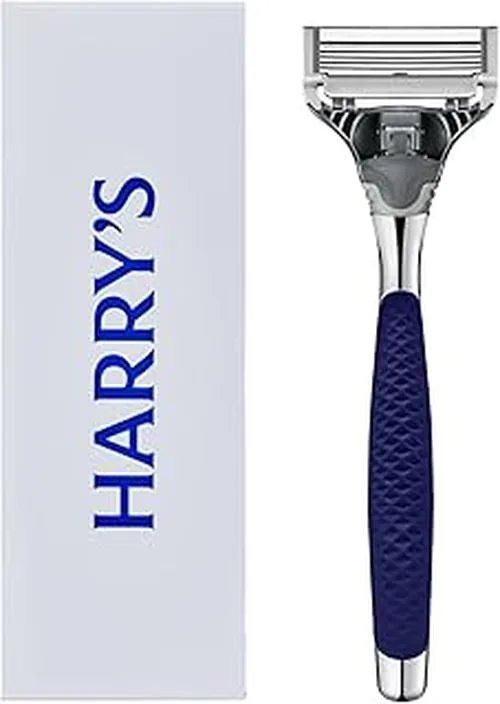
- Harry’s Winston (B0B194HMX4): The detail page explicitly states die-cast zinc. Segmented long handle, diamond mesh plus TPR soft rubber on the grip section, mirror bright chrome on the metal section, deep blue color scheme.

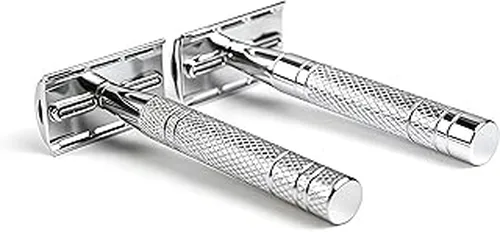
- Zinc Alloy brand DE (B0GKG5PCVW): Brand name is the material. Straight segmented full-handle diamond knurling, mirror chrome.

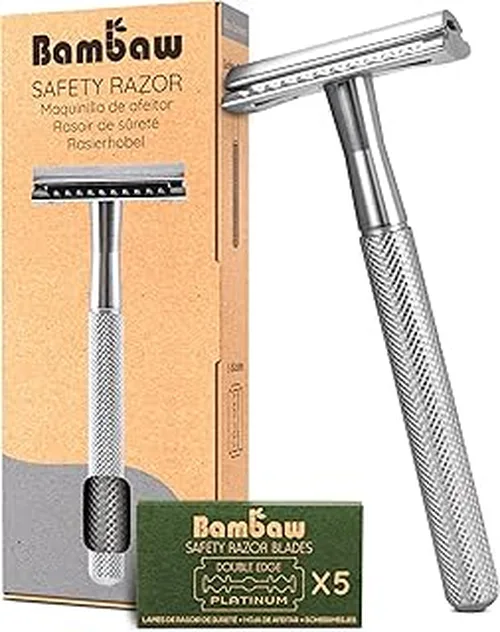
- Bambaw Silver (B07XJQZKL2): Zinc alloy handle with stainless-steel blade. Long, straight, full-handle diamond knurling, bright finish.

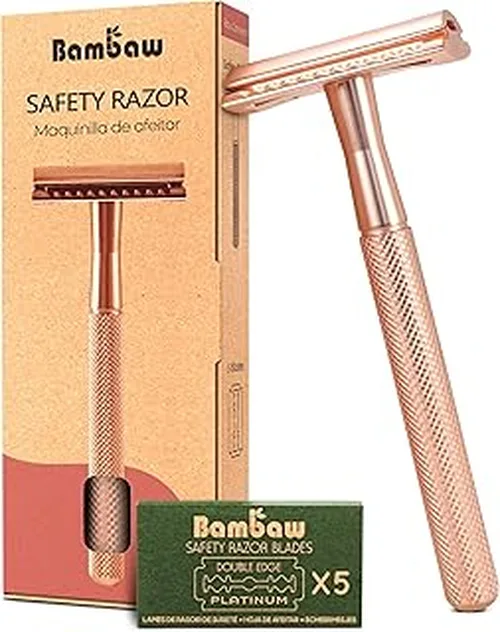
- Bambaw Rose Gold (B07XP6NC9V): Same zinc alloy handle as above, vacuum-plated rose gold, long straight segmented knurling.
- TOCCOOL Grey (B0FHCVBLFF): Compatible with Gillette Fusion 5. Slender straight barrel with a gun-brown brushed finish and mirrored top connector.
- TOCCOOL Silver (B0FDB4JVX8): Compatible with Fusion. Segmented multi-faceted smooth surface plus wood-end splicing, full mirror chrome, multi-directional floating ball head.

- TOCCOOL Gold (B0FHDGP51L): Compatible with Fusion. Straight barrel with circular knurling, vacuum-plated bright gold.
- TOCCOOL Black (B0FBGJ4NQ9): Compatible with Fusion 5 floating head. Streamlined tapered waist with curved surfaces and diamond silicone anti-slip, with orange hinge accent.

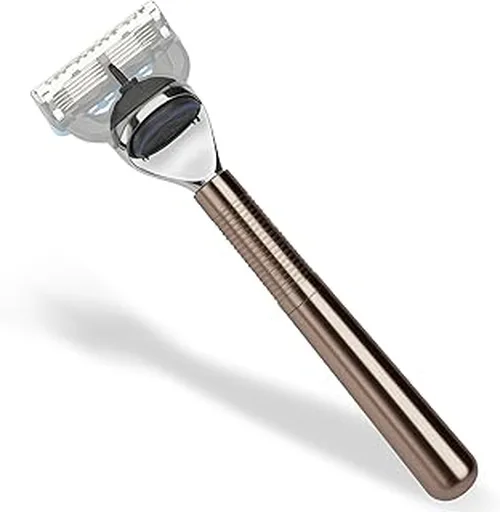
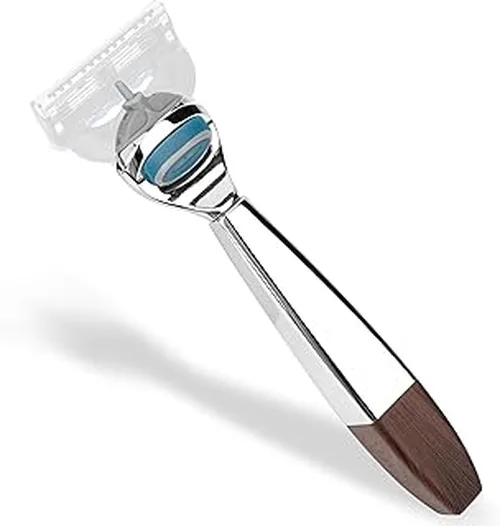
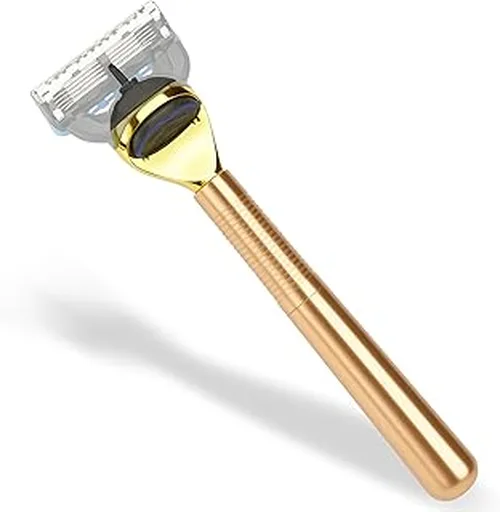
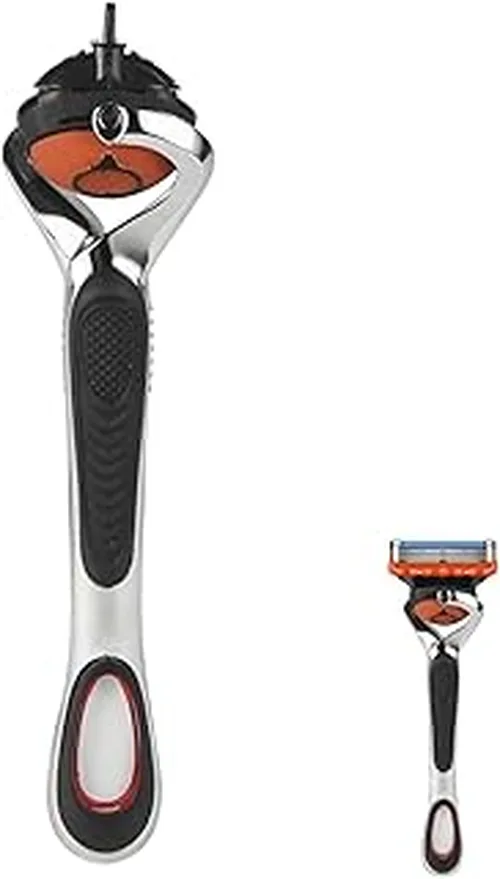
All four TOCCOOL models are compatible with Gillette Fusion cartridges. They target the replacement-handle market—upgrading the feel of the original plastic handle to a metal one. One mold family supports four surface variations: gun-brown brushed, wood-end mirror finish, gold plating, and silicone insert. That is a typical way to use zinc alloy die casting: one tooling platform with multiple finish options to cover multiple style directions.
How to choose material and process for a razor handle
If the target is lightweight, colorful, and a modern look, choose 6061 aluminum CNC. It offers flexible anodized color options, no tooling cost for low-volume runs, and fast design iteration. It fits emerging grooming brands pursuing a minimalist double-edge razor line. If the goal is low weight plus lower unit cost at high volume, select ADC12 aluminum die casting. Its anodizing is limited to black and silver, so color requires paint or plating. If the goal is substantial weight, a glossy vintage appearance, and high-volume production, select zinc alloy die casting. It delivers a heavier hand feel, a mirror chrome texture, and competitive unit cost once tooling is amortized. It fits gift-box products, vintage models, and replacement-handle programs like TOCCOOL’s for existing Fusion or DE product lines.
If the goal is to combine a light outer appearance with a weighted in-hand feel, a structure like Harry’s—die-cast zinc handle with soft rubber grip—or a hybrid build with an aluminum shell and zinc internal weight can do both. Wbmetal has extensive experience with this kind of composite part.
Wbmetal started from zinc alloy die casting. Its core business includes Perfume Caps, Bottle Caps, and metal components for Cosmetic Packaging. The same process line maps directly onto razor handles. Both involve small zinc die-cast parts, glossy plated finishes, anti-slip textures such as knurling or diamond mesh, and the same environmental compliance requirements under REACH and California Proposition 65. For a weighted vintage safety razor handle, or a metal upgrade handle for an existing Fusion or DE product line, Wbmetal can cover the full process from tooling, die casting, CNC, polishing, and plating to final assembly. Available finishes include electroplating, water plating, powder coating, painting, and PVD. Colors and logos can be customized to customer requirements. Salt spray testing can be performed to the required standard. MOQ is 5,000 pieces, and sampling takes 15 days.
If there is already a design concept on hand, even if it is only a sketch, it can be sent over for review. Material choice, wall thickness, draft angle, and plating route can all be defined and converted into tool-ready drawings. From sketch to first sample, the sampling lead time is 15 days.