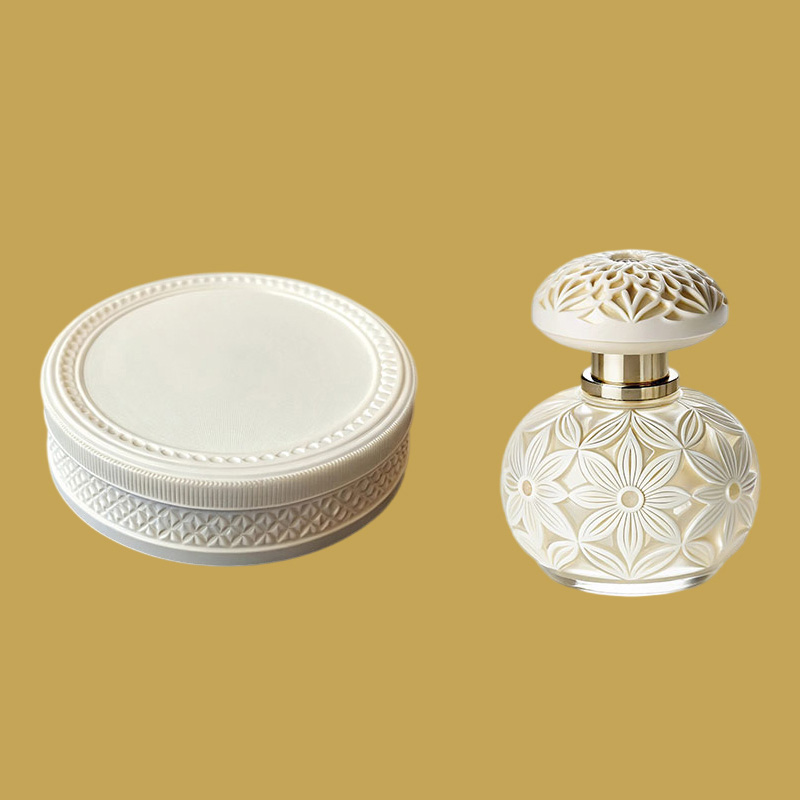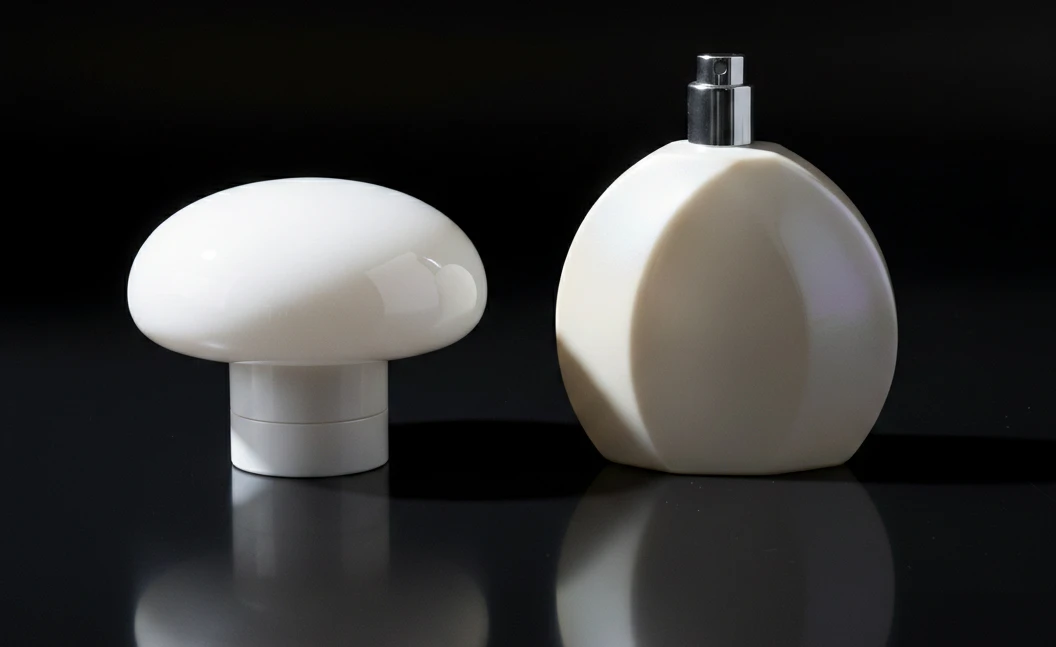
Anyone involved in fragrance packaging components knows that white is the hardest color to produce, and metallic white is even harder. In this case, the client required the electroplated color of a zinc alloy perfume cap to match a pearl white bottle. However, after three rounds of sampling, the project kept failing between tones that were “too cool” and “too warm.” Even after a sample was reluctantly approved, the mass production lot completely failed under natural light and was directly rejected. On the surface, it looked like a color difference issue, but in fact it exposed a chain of long-standing problems. These include differences in substrate reflectivity, fluctuations in electroplating and coating processes, lack of clear color-matching standards, and the disconnect between sampling and mass production. Below, WB Metal Products will break down this real lesson layer by layer.
What Causes Cool-Warm Color Differences Between Zinc Alloy Perfume Caps and Pearl White Bottles?
The main reasons why a zinc alloy perfume cap and a pearl white bottle may appear “one cooler and one warmer” are basically the following:
- Different substrates: The zinc alloy cap relies on electroplating/spray coating, while the bottle body is mostly plastic or glass. Their substrates reflect light differently, so it is naturally difficult to make them look the same.
- The special nature of pearl white: Metal and plastic/glass substrates have different light refractive indices (plastic 2.0 vs. glass 1.5). Under the same light source, the metal cap tends to reflect a cooler bluish tone, while the plastic bottle tends toward a warmer yellowish tone. Combined with the scattering effect of pearl pigments, the color difference is amplified even further.
- Process differences: Inconsistent coating thickness and gloss level can make the cool-warm tone look wrong to the naked eye, even if the lab values are close.
- Electroplating variation: Inadequate pretreatment, plating bath composition, temperature, current, time, and rack position can all cause the color depth of the zinc alloy perfume cap to shift (easily resulting in an out-of-tolerance △E > 1.5).
- No unified supply chain control: If the bottle and cap are not controlled using the same standards, approved samples, and inspection methods, the color difference can easily become magnified.
Why Was There Still Color Difference After Three Sampling Rounds for the Zinc Alloy Perfume Cap?
| Reason | Why It Still Failed After Three Sampling Rounds |
|---|---|
| Standards were not clearly fixed | They only said “close to the customer sample” without clearly defining Pantone/physical standard, Lab values, ΔE limit, viewing light source, and angle. Repeated sample exchanges under such conditions are the easiest way for color to drift. |
| Inconsistent substrate | Differences in zinc alloy material composition, surface condition, die-casting condition, and polishing roughness can all change reflectivity and warm/cool appearance after plating. |
| Electroplating process variation | Differences in chemical batch, nickel/chromium ion concentration, plating solution concentration, current density, pH, temperature, filtration, and coating thickness naturally create color variation between sample rounds. |
| Pretreatment control was missed | If degreasing, polishing, and surface cleaning are not properly done, the color may become mottled or darkened and fail to match the approved zinc alloy perfume cap sample. |
| The process itself was not matched | If the customer’s color standard was made by another process, but you try to reproduce it through electroplating, the direction is already wrong from the start. |
Why Can the Color Difference in Mass Production of Zinc Alloy Perfume Caps Be Much Worse Than in Sampling?
If the zinc alloy perfume cap sample passed, but the mass production batch shows much greater color difference, it is usually because mass production went out of control:
- Plating solution concentration fluctuated (causing uneven metal ion deposition), chemicals aged, or current/time settings were adjusted
- Samples were evenly hand-polished, while mass production used machine polishing and insufficient pretreatment
- Pigment batch differences occurred (ΔE value exceeded 1.5)
- Inspection was conducted only under natural light instead of using a D65 light box and ΔE standard
- Even a small ΔE may still lead to visible differences due to metamerism, meaning the appearance changes under different lighting conditions
How Can the Risk of Color Inconsistency Between Sampling and Mass Production of Zinc Alloy Perfume Caps Be Avoided?
| Stage | Color Difference Prevention Method for Zinc Alloy Perfume Caps |
|---|---|
| Fix the standards first | The contract should clearly specify ΔE≤1.0, about ASTM B456 and ASTM D2244; customer standard panel plus upper and lower limit sealed samples; Pantone records retained; and the colorimeter model and measurement conditions designated (such as X-Rite Ci7800, D65 light source). |
| Do not judge sampling only by appearance | Mass production should begin only after first article approval (including ΔE measurement). Sampling and production should use the same batch of paint, the same parameters, and the same equipment. |
| Production process | Pretreatment must be done first: degreasing, dewaxing, and drying; primer/topcoat film thickness, oven temperature, humidity, and spray gun calibration should all be controlled regularly; add online colorimeter monitoring for real-time supervision, with an alarm triggered when fluctuation exceeds 0.5. |
| Shipment acceptance | Use the designated colorimeter under a standard light box to conduct random inspection against the sealed sample according to ΔE≤1.0; if necessary, use AQL sampling or 100% inspection for color difference. |
How to Identify the Key Risk Points
| Risk Point for Zinc Alloy Perfume Caps | Most Common Pitfall | Judgment Signal |
|---|---|---|
| Do not judge only by appearance | The surface may look beautiful, but internal thread precision, sealing performance, and porosity/shrinkage were not checked, so problems only appear after assembly. | Review material reports and third-party certificates, and conduct functional testing if necessary; a qualified appearance does not mean it is safe to accept the goods. |
| Coating peeling/corrosion | Poor pretreatment and drifting electroplating parameters result in unstable adhesion, leading to plating peel-off, mottling, and poor corrosion resistance later. | Ask the supplier to provide salt spray test reports per ASTM B117, cross-cut adhesion reports per ISO 2409/ISO 2819, and alcohol immersion test reports. |
| Compliance and batch consistency | The goods are exported to Europe without RoHS or REACH compliance; dimensional deviation occurs in mass production, resulting in unstable batch assembly. | Verify RoHS 2011/65/EU, REACH 1907/2006, and dangerous goods transport certifications (such as UN38.3/IMDG); during the mass production stage, pay attention to dimensional inspection and QC procedures. |