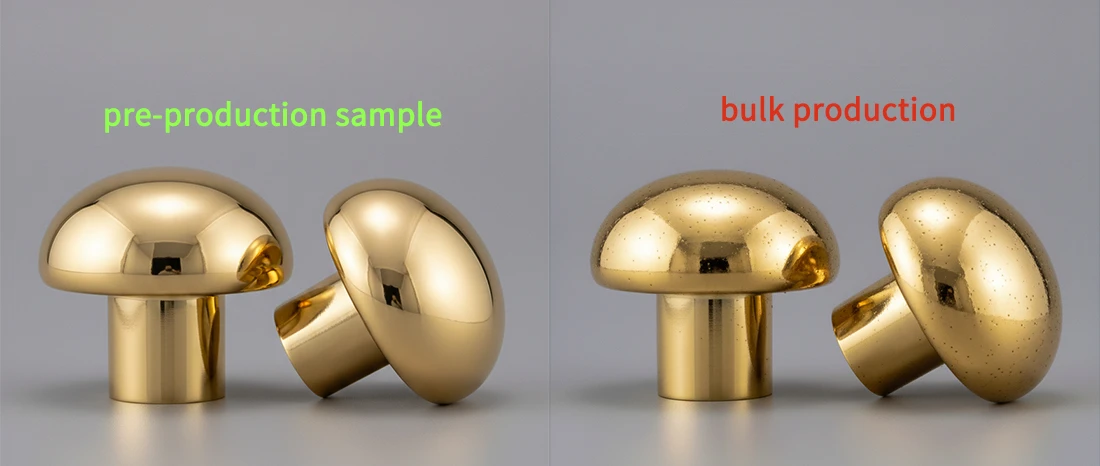
Recently, we learned of a typical cross-border supply chain quality dispute: before shipment, a random inspection of 50 zinc alloy perfume caps was judged fully qualified, but after the goods were sent to a U.S. customer and subjected to 100% inspection, an 8% defective rate was found. The issues were concentrated in two categories: thread seizure and plating spots. The customer requested a full return, while the factory and the intermediary disagreed on liability attribution. As a result, the intermediary, customer, and factory all suffered multiple losses in logistics, rework, and reputation. To help B2B buyers and traders avoid such risks, Wbmetal has systematically summarized the core causes, emergency responses, and solutions for these two issues.
Why Do Zinc Alloy Cap Threads Seize?
The following list shows common causes of thread seizure in zinc alloy caps:
| Stage | Specific Cause | Impact |
|---|---|---|
| Post-treatment | Plating layer too thick | Clearance is filled, causing interference fit and seizure. |
| Post-treatment | Insufficient anti-rust treatment | Oxidation and corrosion create raised areas that cause seizure. |
| Assembly | Excessive torque or misalignment | Thread stripping or thread profile damage. |
| Assembly | Foreign matter not cleaned | Residue obstructs thread engagement. |
| Design | Small fit clearance or unreasonable tolerance | Dimensional interference causes seizure. |
| Design | Thread angle deviation | Thread profile mismatch makes engagement difficult. |
| Storage and use | Difference in thermal expansion coefficient | High temperature causes overtightening and seizure. |
| Storage and use | Intergranular corrosion or galvanic corrosion | Corrosion products adhere and cause seizure. |
| Storage and use | Insufficient lubrication or high humidity | Increased friction or thickened oxide layer. |
Steps to Solve Thread Seizure After Plating of Zinc Alloy Perfume Caps
1. Problem stage: Thread seizure occurs after plating is completed, mostly due to increased coating thickness, residual matter, or slight thermal expansion of the material during the plating process, resulting in an excessively tight fit.
2. Cause investigation: Measure the threads to confirm whether the coating is too thick; check whether plating solution or oil residue remains inside the threads; verify whether plating allowance was reserved in the machined pilot hole.
3. Emergency handling: Use compressed air or a dedicated cleaner to remove thread residue; when seizure is minor, use a low-torque tool together with lubricant to repeatedly loosen the thread.
4. Preventive optimization: During machining, enlarge the pilot hole by 0.08-0.15 mm according to the plating thickness (the specific value may be fine-tuned based on the actual plating type and thickness); strengthen degreasing and cleaning after machining and before plating; coordinate with the plating supplier to control coating uniformity.
5. Note: If the seizure is severe, the thread must be reworked and remade, while the above preventive measures should be implemented simultaneously.
Why Do Zinc Alloy Caps Have Plating Spots?
1. Analysis of the causes of plating spots
Base material: excessive impurities, die-casting defects, release agent residue
Pretreatment: incomplete degreasing, improper activation, insufficient rinsing
Plating process: parameter imbalance, abnormal current, fixture problems
Post-treatment: inaccurate passivation, poor sealing, cleaning residue
Environment and equipment: improper humidity control, dust contamination, unstable equipment operation
Solutions to Avoid Plating Spots
Base material storage: use low-impurity zinc alloy (lead ≤ 0.005%), with incoming inspection; storage humidity < 60%, storage time ≤ 7 days, and anti-rust packaging.
After die casting: hot alkali washing (50-60 g/L NaOH, 60-70℃, 5-8 min), high-pressure water rinsing, and controlled use of release agent.
Pretreatment: alkali washing + ultrasonic degreasing, activation with dilute sulfuric acid + ammonium bifluoride, then rinse with clean water and blow dry.
Plating bath: activated carbon filtration every week; copper ion 20-40 g/L, pH 10.0-12.0; regularly remove heavy metals, and do not use iron tools.
Electroplating: adjust current density according to the process; polish fixture contact points to ensure firm contact.
Post-treatment: passivation solution pH (iridescent 2.0-3.0 / clear 1.5-2.5), checked daily; deionized water rinsing; sealing; hydrogen de-embrittlement (120-150℃, 2-4 h).
Why Could 50 Samples Not Detect the Problem?
Insufficient sample size: 50 samples are too few, statistical precision is low, and the confidence interval is wide, so the defective rate cannot be accurately measured.
Sample representativeness issue: sampling did not cover the full process, so the samples were not representative of the entire lot.
Large fluctuation in defect rate: defects are sporadic, and when the defect rate is at a relatively low level, fluctuation may be large, making small-sample error significant.
Sampling not conducted according to standards: a fixed sample size of 50 may not comply with the principles of sampling standards such as GB/T 2828.1; sample size should be dynamically determined according to lot size and AQL.
Uneven defect distribution: defects may occur in clusters, and fixed samples may miss defective clusters, leading to misjudgment.
Insufficient detection of latent defects: latent defects require destructive testing, and small samples are more likely to miss them.
Inconsistent acceptance criteria: vague defect definitions and subjective differences among inspectors cause result fluctuations.
Insufficient data volume: too few samples make SPC analysis impossible and make it difficult to assess process stability.
Why Did the Customer Find an 8% Defective Rate?
Before shipment, all 50 sampled pieces passed inspection, but the defective products were evenly dispersed, with every 100 products per carton containing defects. The probability of catching them in random sampling was extremely low, even lower than winning a lottery, so they directly escaped quality inspection. However, the customer adopted 100% inspection and therefore identified an 8% defective rate, mainly thread seizure and plating spots.
How Should This Problem Be Handled?
Thread seizure and plating spots in zinc alloy caps caused losses to all three parties:
| Party Suffering Loss | Lost Content |
|---|---|
| Intermediary | Logistics / rework / penalties for breach / capital occupation / warehousing / re-inspection; indirect losses: decline in customer trust, damaged reputation, order loss |
| Customer | Labor for 100% inspection / rework / delay penalties / customer complaint compensation / urgent logistics; indirect losses: disrupted production schedule, brand reputation loss, declining employee morale |
| Factory | Return logistics / rework / line stoppage compensation / expedited replenishment / payment deductions; indirect losses: reduced orders, lower supplier rating, increased new customer development cost |
1. Solution for the return issue: Defective products that have already been identified can be sorted out, and the good ones should be used first. Negotiate to remake the remaining quantity, identify the cause, and determine who should bear the cost or whether it should be shared equally. Let the customer ship the acceptable goods first, and set a timeline to complete the remaining quantity as soon as possible, minimizing the customer’s sales losses.
2. Thread inspection: 100% inspection with GO/NO-GO gauges (GO gauge fully screws through the entire thread, NO-GO gauge ≤ 2 threads); torque testing (according to customer torque requirements); 100% trial assembly with customer mating parts.
3. Plating spot inspection: Inspect under a 40W fluorescent lamp at 30-50 cm using a 5x-10x magnifier; neutral salt spray test (according to customer requirements or relevant standards, such as 48 h), with plating spots ≤ 1% (the specific ratio shall be implemented according to the standard); degreasing inspection (wipe with white cloth, no oil contamination allowed).
4. Process optimization: three-stage quality inspection (thread integrity check after CNC machining → initial inspection after plating with GO/NO-GO gauges + spot inspection → final finished-product inspection with simulated assembly + salt spray sampling).
Summary Recommendations
This dispute involving zinc alloy caps exposed the limitations of random sampling: a sample of 50 pieces is like casting a net for small fish, making it difficult to catch an 8% defect rate involving thread seizure and plating spots. Only after the customer conducted a 100% inspection was the problem discovered, resulting in losses for all three parties. The root causes lie in the electroplating process and design tolerances. The solution requires robust measures such as 100% inspection with GO/NO-GO gauges, torque testing, and salt spray testing. Only by optimizing the three-stage quality inspection process and controlling issues at the source can supply chain risks be avoided.