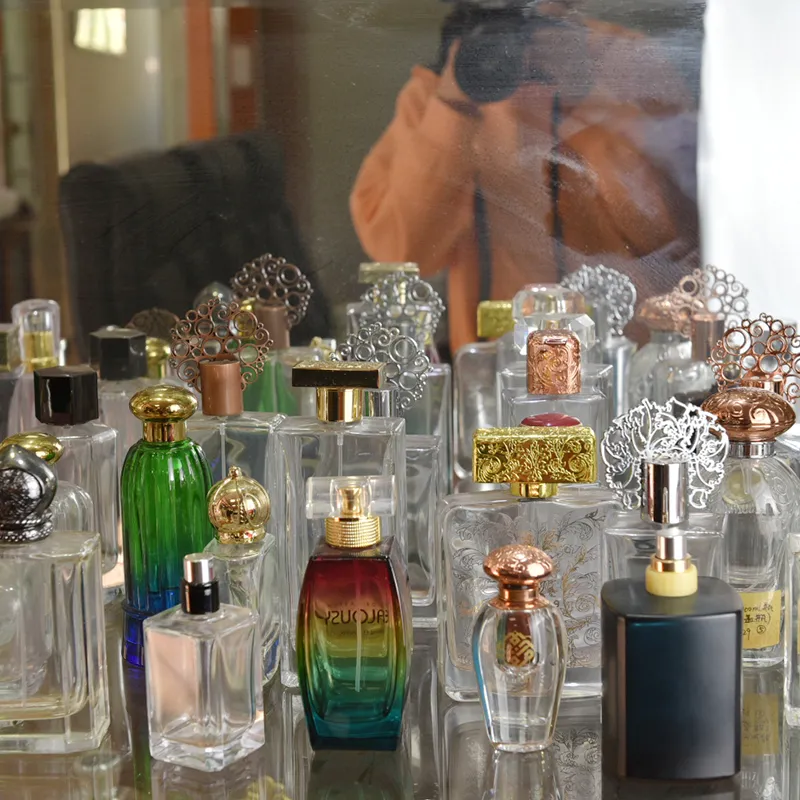
I. Core Pain Points: The Two-Way Dilemma Between Customers and Factories
In the development of new zinc alloy perfume caps, the lack of 3D drawings from customers is the key contradiction that causes factories to hesitate to quote prices and leads to inefficient communication on both sides.
Customer Pain Points:
- No Basis for Quotation: Without 3D drawings, most factories refuse to quote. A few suppliers may charge modeling fees (typically around USD 140+, depending on design complexity), but unreasonable designs (such as improper wall thickness) often cannot be manufactured, resulting in wasted costs.
- Distorted Requirement Communication: Verbal descriptions or vague sketches easily lead to misunderstandings. After sampling, issues such as size mismatch (e.g., bottleneck clearance errors) or stiff opening/closing are discovered, and rework usually takes 2–3 months.
- Design Cost Traps: Drawings from third-party design studios may be overly complex, doubling factory quotations. Simplifying the design requires additional modification fees, putting customers in a difficult position.
Factory Pain Points:
- High Quotation Risk: Estimating costs based only on verbal descriptions or unclear photos can lead to major deviations. For example, estimating a weight of 5 g from photos while the actual weight is 7 g results in over 40% higher material costs. Missing process details (e.g., later requests for mirror polishing + PVD coating) can increase costs by 2–4 times compared to standard electroplating.
- Low Communication Efficiency: Customers refuse to provide samples or drawings but urge factories to “quote first,” which is often seen as a lack of sincerity. Incomplete photo angles and no reference objects (e.g., no diameter markings) make quotations little more than guesswork.
- Unclear Responsibility Boundaries: After verbally confirming dimensions, customers may request rework citing confusion between inner and outer diameters. Without written records, factories often have to bear mold modification costs themselves.
II. Practical Solutions: Optimizing the Full Process from Requirements to Quotation
To solve quotation difficulties caused by missing 3D drawings, breakthroughs are needed in three areas: requirement clarification, technical tool support, and process risk control, enabling efficient collaboration between both parties.
(1) Requirement Clarification: Three Key Actions to Reduce Information Gaps
1. Provide “Minimum Standard” Reference Materials
- Physical Samples: Customers send samples or allow on-site measurement. Factories use calipers to record key dimensions (diameter, height, wall thickness) and create hand-drawn sketches for customer signature confirmation. Industry experience shows this can reduce dimension disputes by about 60%.
- Annotated 2D Drawings: Customers provide hand sketches with key dimensions (e.g., diameter 35 mm, wall thickness 1.5 mm) or photos of similar products with reference objects (such as a ruler in the photo), avoiding “guessing dimensions from distant photos.”
- Standardized Requirement Forms: Factories provide option-based forms for customers to select diameter ranges (30–35 mm / 35–40 mm), surface finish (chrome plating / spray coating), function (press-fit / screw-on), and order volume (1k / 5k / 10k units), reducing vague descriptions.
2. Clarify Process-Related Cost Information
- Customers should clearly specify surface treatments (e.g., standard electroplating vs. mirror polishing + PVD coating, with cost differences of 2–4 times), weight ranges (common zinc alloys such as Zamak 3 have densities of 6.6–6.7 g/cm³, and weight directly affects material cost), and whether logo grooves or threads are required (which impact mold complexity).
(2) Technical Tools: Practical Methods for Rapid Modeling and Cost Estimation
1. Low-Cost 3D Modeling Support
- Factory Side: Use FreeCAD (open-source software) to convert customer 2D drawings into 3D models. Workflow: import 2D files → trace outlines using the “Draft” workbench → extrude based on wall thickness (e.g., 1.5 mm) → measure volume to estimate material cost.
- Customer Side: Use Tinkercad (free online tool) for real-time collaboration. Based on customer descriptions, factories can generate a basic model (e.g., cylinder diameter 38 mm, height 18 mm) within one hour and confirm structural details (press area, logo position) via screenshots.
2. Reverse Engineering and Simulation Validation
- If customers have samples, handheld 3D scanners (rental USD 70–140 per day) can be used to generate point cloud data. Models are refined using MeshLab software to ensure dimensional accuracy (tolerance ≤ 0.1 mm).
- Factories can use Moldflow simulation to predict issues such as shrinkage porosity or uneven wall thickness, and communicate design adjustments (e.g., adding venting) with customers in advance to avoid later disputes.
3. Responsibility and Flexibility Clauses
- Quotation notes should state: “This quotation is based on the current samples/2D drawings. Final pricing is subject to confirmed 3D drawings. Price variance by complexity: simple designs (no logo, smooth surface) ±5%; complex designs (multi-curvature + PVD coating) ±12%,” effectively reducing future disputes.
- Design responsibility agreements: After customer confirmation of 3D drawings, sampling fees include design costs. For mass production orders reaching 50,000 units, 50% of the design deposit can be refunded—balancing risks for both parties.
III. Conclusion: Core Principles for Efficient Collaboration
The key to quoting without 3D drawings lies in replacing vague communication with clear requirements, technical support, and defined processes. Customers should proactively provide samples, 2D drawings, or detailed parameters, while factories leverage low-cost modeling tools. By relying on written records (such as signed sketches and quotation terms), both sides can significantly reduce communication costs and disputes, enabling smooth transition of zinc alloy perfume caps from design to mass production.