Not always. Two perfume caps can both look gold-plated even if one gets its color from a gold alloy and the other from brass. To make the gold shade lighter, first identify what gives the finish its color and how that layer was applied.
How Does Metal in a Plating Bath Become a Coating?
Take acid copper plating in a copper sulfate bath. Once the zinc alloy cap has a suitable undercoat, it is immersed in the bath and connected to the negative terminal of the power supply. When current flows, copper ions in the bath gain electrons at the cap surface and become metallic copper. As more copper deposits, the metal layer builds up.
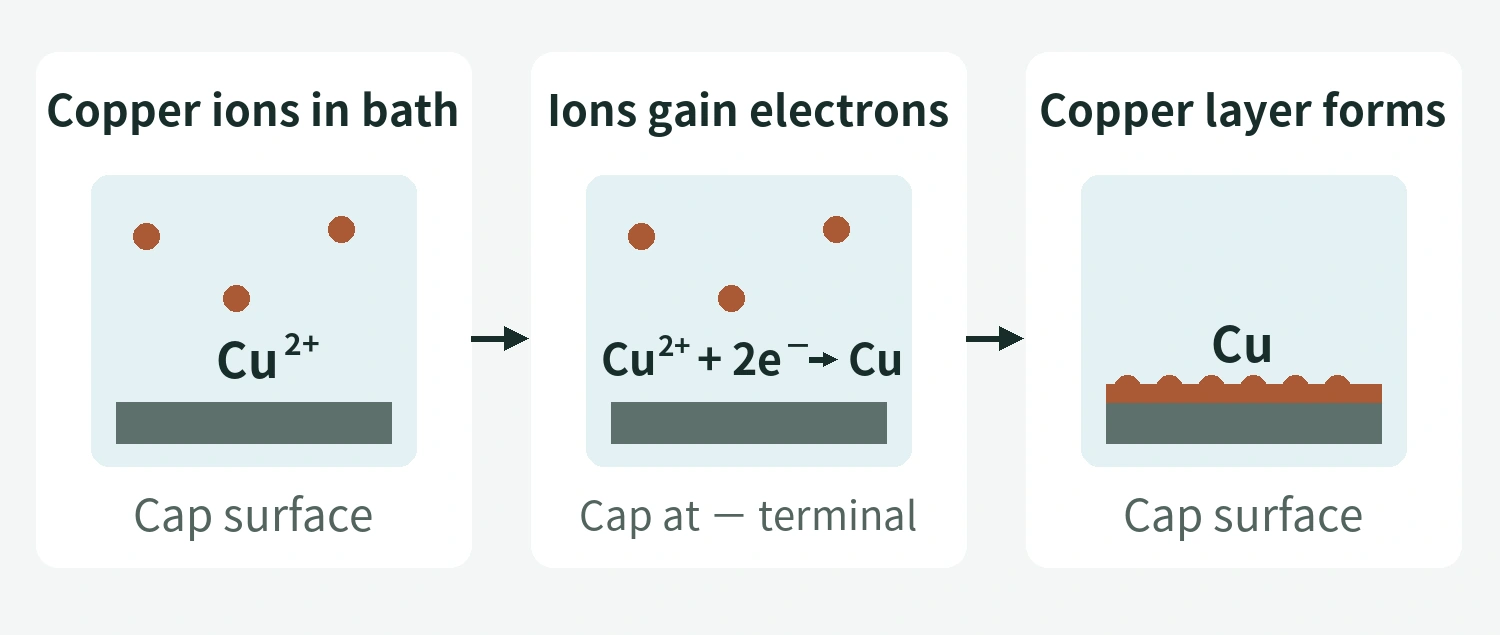
Detail of copper deposition in an acid copper sulfate bath. The undercoat is omitted from the diagram.
The cap body is still zinc alloy. Copper forms a layer at its surface. For a decorative finish, a separate layer that provides the color can be plated over the undercoat. See Electroplating vs. PVD: What’s the Difference? for the complete electroplating and physical vapor deposition (PVD) processes.
How Is the Gold Color Adjusted in Electroplating?
If the gold color comes from an electroplated layer, adjust the bath used to deposit that layer. In brass plating, for example, the bath supplies both copper and zinc. A different bath formulation, or changes to temperature and current density within the working range, can change how fast the two metals deposit relative to each other. That shifts the copper-to-zinc ratio in the deposit and can change its hue.
What matters here is the copper-to-zinc ratio in the deposit. In one series of brass plating tests using a high-metal-content bath, deposits with higher copper content looked more copper-colored, while samples with 65%–75% copper appeared broadly similar in yellow hue. The same coating can also reflect light differently on a polished surface and on a textured one.
How Are Four Types of Gold-Colored Finishes Made?
Gold electroplating. Current passes through a gold-bearing bath, depositing gold or a gold alloy on the cap. Different decorative baths deposit different compositions, including gold alloy finishes in pale yellow or rose gold shades.
Imitation-gold electroplating. Brass plating also uses current in a plating bath. Copper and zinc deposit together, forming a copper–zinc alloy layer that can look golden yellow.
Gold-colored PVD. Take reactive sputtering as an example. In a vacuum chamber, argon ions strike a titanium target and release titanium. The titanium reacts with nitrogen to form a gold-colored titanium nitride (TiN) film on the cap. The target material or reactive gas can be adjusted to change the shade, depending on the coating system.
Gold-colored spray coating. A spray gun applies liquid paint containing gold-effect pigments. When the coating dries or cures, the pigments remain in the paint film. Gold-colored paint can use aluminum-based effect pigments. The shade is adjusted through the pigments and the paint formulation.
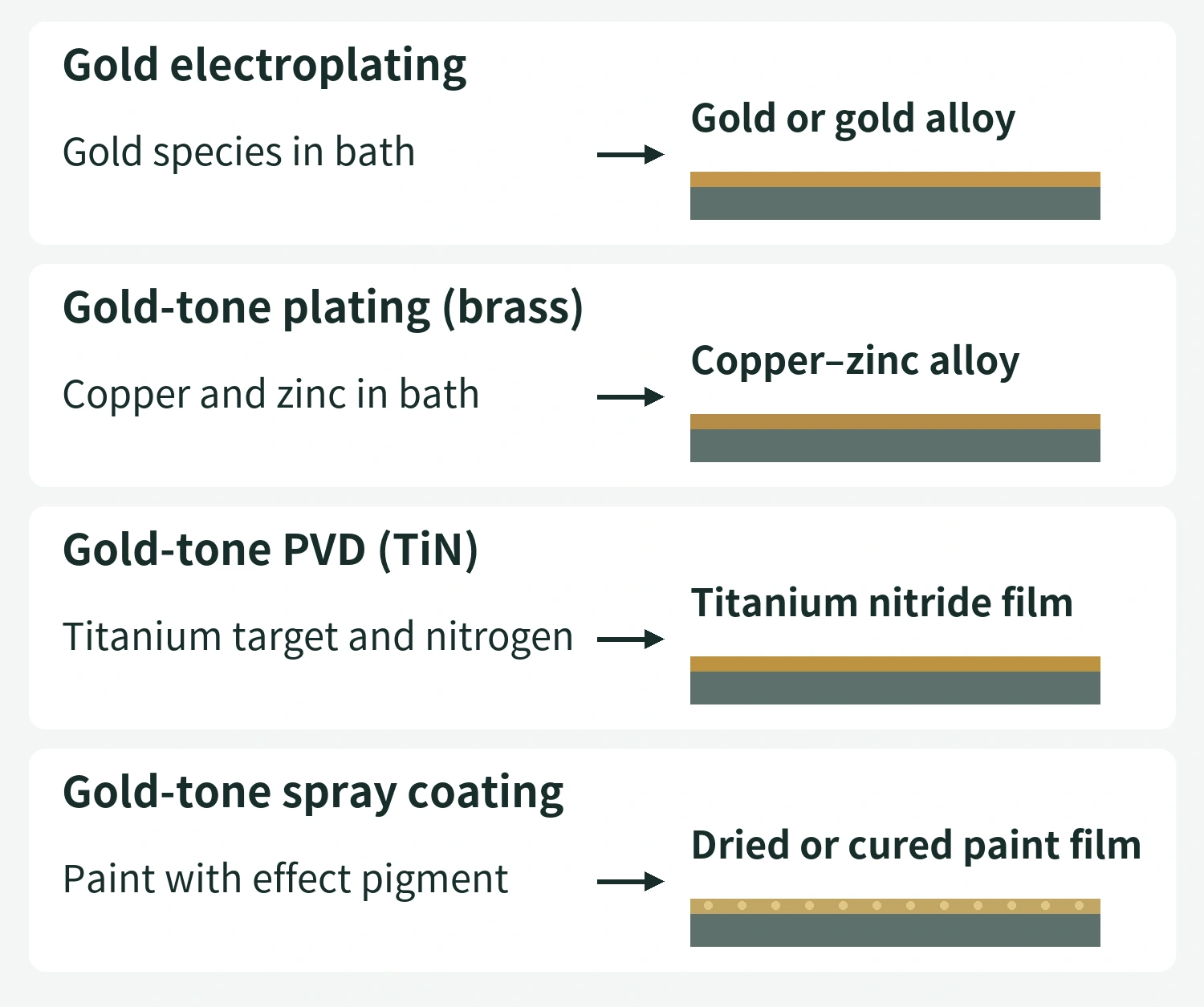
The diagram shows the layers that provide the color. The full finish may include an undercoat or a clear coat. The colors and thicknesses are illustrative.
If a finish specification only says “gold-colored,” it describes the appearance. To confirm whether the cap is gold-plated, check whether the specification lists a layer that contains gold and whether that layer was applied by electroplating.